

As artificial intelligence reshapes how organisations operate, business leaders face a fundamental question: how do you lead change effectively in the AI era? For Rethink Group, the answer lies in embracing transformation at its core, not as a bolt-on initiative, but as a strategic imperative.
In November 2025, the Group committed to a comprehensive AI transformation, with full rollout commencing January 2026. We spoke with CEO Scott O’Neill and Head of Growth Rebecca Maher about what this means for business leaders navigating similar decisions.
From manual processes to AI-augmented operations
For many organisations, operations still rely on slow, manual processes including spreadsheet analysis, paper-based workflows, and cumbersome data entry that make it difficult to respond quickly to market changes. Generative AI takes this further by enabling organisations to synthesise data, analyse information, and plan projects in real-time.
Rethink Group’s journey began in August 2024 with its first proprietary AI tool. Rethink Investing built it to solve a specific problem: Acquisitions Specialists were losing hours each week to manual data entry and document formatting. The tool automated the workflow and delivered an efficiency gain of 86%.
But the efficiency gain wasn’t the point. What mattered was what it enabled.
“The real value was unlocking capacity for the work that matters,” Maher says. “The team can now focus on building relationships and sourcing quality investment opportunities. That’s where the value is created.”
That early win prompted a bigger question: a diagnostic review across all businesses, mapping workflows, identifying friction points, and stress-testing where AI could genuinely add value.
For business owners, this is a good place to start: identify where manual work is creating friction, then test whether AI can remove it.
“What we uncovered was an opportunity to fundamentally reshape how we deliver our services,” Maher says. “Not by adding more tools, but by rethinking the model from the ground up.”
Why bolt-on AI fails
Traditional change management has often been guided by rigid methodologies and “best practice” frameworks. In complex environments, these approaches tend to stall. Formulaic processes that don’t account for organisational context underperform.
“You can’t just layer AI on top of how you’ve always done things,” she says. “You need to tie it to your business strategy, re-engineer workflows, get buy-in, and support your people through education and training.”
A bolt-on approach typically produces short-term lift but long-term inconsistency. Workarounds multiply, quality varies, and employees revert to old ways of working. By contrast, integrated transformation redefines the operating model itself.
Integrated transformation and open strategy
Effective transformation requires integration between business strategy, project management, and change management. Where these three disciplines intersect, transformation moves faster. Historically, change management was treated as an add-on, people insights were tick-box activities rather than inputs into decision-making. That separation is disappearing as organisations recognise integrated approaches deliver better outcomes.
Research indicates that when employees own implementation planning, change success increases significantly. Open strategy, where teams are involved early rather than presented with decisions made behind closed doors, builds ownership and accelerates execution.
The Group’s AI transformation has been endorsed by its business directors as a strategic imperative, reflecting this participative approach.
O’Neill says this alignment is essential for speed and quality. “Our teams understand the practical realities of client work better than anyone, so involving them early ensures the system we build actually works on the ground.”
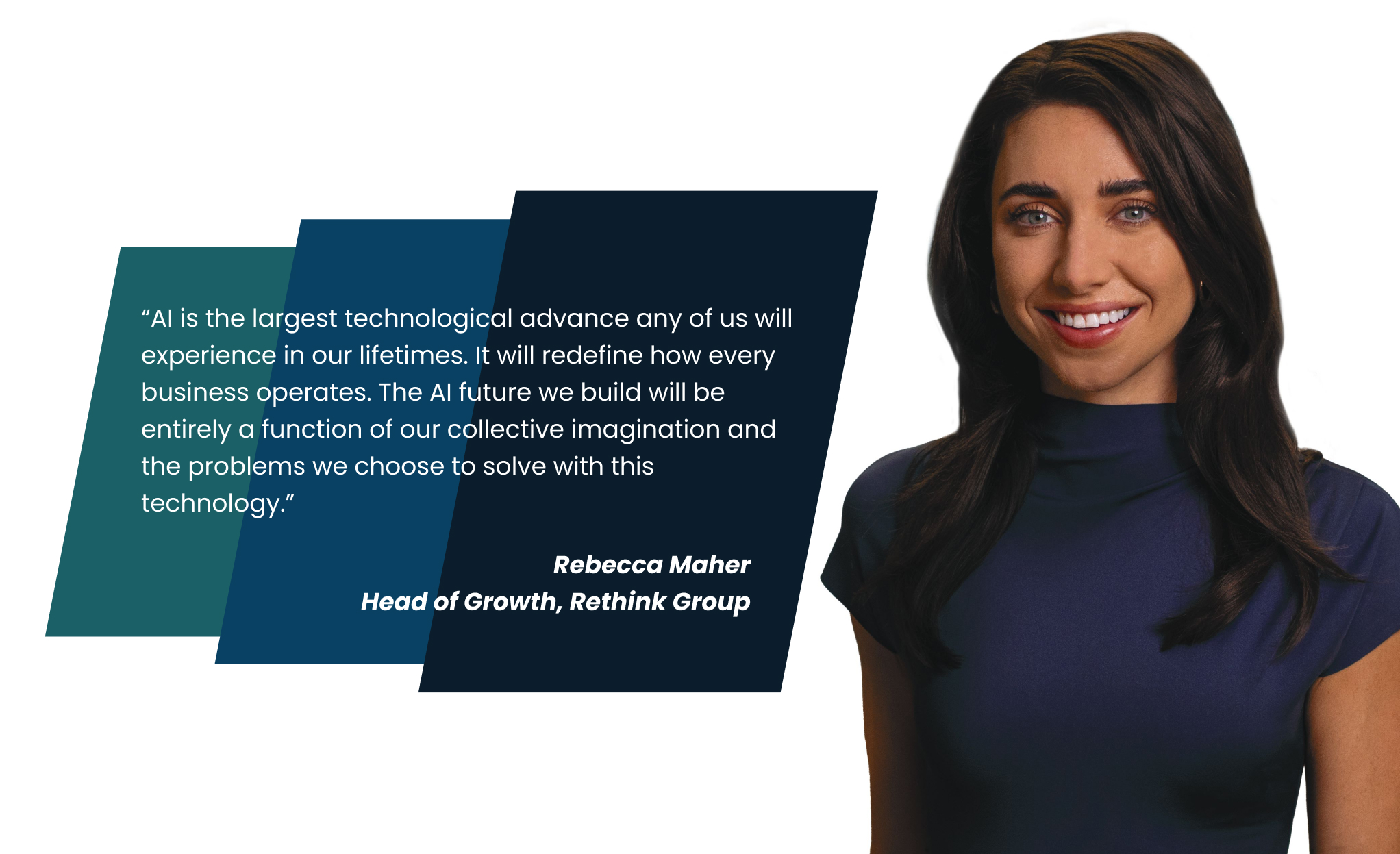
“Through AI, we’re building systems that scale efficiently, elevating our people to focus on higher-value work, and positioning Rethink Group as a leader in how property services evolve,” O’Neill adds.
For clients, this translates into faster turnaround times, more consistent deliverables, richer insights, and a more proactive service model — all advantages that will strengthen over time as data and systems mature.
Culture as a strategic lever
Successful transformation depends on culture and psychological safety. Business leaders now see clearer links between constructive cultures and successful outcomes. Those who understand cultural dynamics and adjust their approach accordingly tend to accelerate adoption and reduce risk.
O’Neill frames the decision as strategic positioning rather than reactive necessity.
“Our fundamentals are strong — great product, talented people, trusted brand. But technology is reshaping how property services are delivered, and we made the call to lead that change rather than react to it.”
The compounding advantage
For Rethink Group, the transformation represents a compounding advantage — one that builds over time.
“This transformation compounds over time. It’s how we’ll future-proof the Group and deliver long-term value,” O’Neill says.
“I started Rethink Group to disrupt how professional services were delivered. We did it once when we were the first to enter the commercial market. Now we have the chance to do it again, at a much bigger scale.”
The AI era demands a more sophisticated approach to leading organisational change. Business leaders will be more effective if they use AI-enabled tools, flexible frameworks, and integrated approaches combined with cultural intelligence. By developing these capabilities now, organisations position themselves to navigate an increasingly complex environment with confidence.
For business owners navigating similar decisions, we’re happy to share what we’re learning along the way. Rethink Group will share key learnings and practical frameworks throughout 2026, supporting business owners who are considering their own AI adoption. If you’d like access to those insights, the team welcomes conversation. Sometimes the most valuable insight comes from seeing how others are leading their businesses through the same opportunity.










.webp)


